
Keyway vs Screw-Clamp Mesh Fixing
October 14th, 2026
Key Takeaway
- A security screen is only as strong as the way its mesh is held in the frame.
- Keyway vs screw clamp is the key difference: most screens clamp the mesh edge with screws.
- All CommandeX screens use the Australian patented keyway system instead.
- The mesh is locked into a keyway with a two-part wedge, and that pressure activates a VHB™ bond.
- No screws or rivets hold the mesh.
- A clear gap between the infill and frame eliminates the opportunity for galvanic corrosion.
Why the fixing system matters
Most people compare security screens by the mesh: stainless steel or aluminium, 304 or 316. But when someone tries to force a screen, the weak point is rarely the middle of the mesh. It’s the edge, where the mesh meets the frame.
That join takes the load in the tests that matter. In Australian Standard AS5039-2023 testing, the impact and pull tests put real force on the mesh edge. If the fixing gives way, the mesh pulls out, however strong the mesh itself is.
The fixing also decides how a screen ages. Every point where two different metals touch is a spot where corrosion can start, especially near the coast.
How screw-clamp systems work
Screw-clamp is the most common way to fix security mesh in Australia. The mesh edge sits in the frame and a clamping strip is screwed down over it, gripping the mesh in place.
It’s a proven method, and well-made screw-clamp screens perform strongly. A few things are worth asking about:
- Many fasteners per screen – The grip relies on dozens of screws staying tight over the life of the screen.
- Metal-to-metal contact – Stainless steel mesh and screws pressed against an aluminium frame are dissimilar metals. Add salt air and moisture, and that contact is where galvanic corrosion can begin.
- The look – Some systems leave screw heads or clamp strips visible on the frame.
How CommandeX’s keyway system works
CommandeX developed its own approach, an Australian patented fixing method used on all our screens.
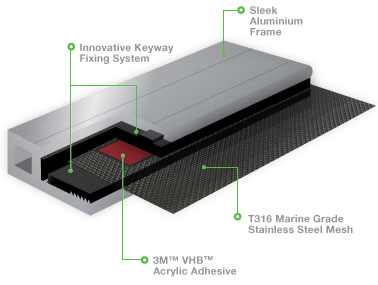
- The keyway – The mesh edge is fed into a keyway channel built into the aluminium frame.
- The two-part wedge – A two-part wedge, made from UV-stabilised PVC, is driven into the keyway. It’s designed to create exactly the right pressure on the mesh edge.
- The 3M™ VHB™ bond – That pressure activates 3M™ VHB™ acrylic bonding to its full potential, a chemical bond proven strong enough to replace rivets.
- The frame – A lightweight extruded aluminium frame, reinforced with solid aluminium stakes at each corner joint and finished in gold-accredited Interpon™ powder coat, including the latest Colorbond™ colours.
The result is a mesh edge held two ways at once: mechanically locked by the wedge in the keyway and chemically bonded by the VHB. That’s what we call a dual-bond fixing.
Because there are no screws or rivets holding the mesh, and the design keeps clear spacing between the infill and the frame, there’s no metal-to-metal contact at the edge. That eliminates the opportunity for galvanic corrosion, which is a big reason it pairs so well with 316 marine-grade mesh and our SaltWaterSeries for coastal homes.
The acrylic VHB™ adhesive is also viscoelastic, which gives it superior energy-absorbing properties and helps eliminate stress points. When a screen takes a hit, the bond helps absorb the impact rather than concentrating it on a handful of screw points.
Side by side
| Feature | Screw-clamp | CommandeX keyway |
|---|---|---|
| How the mesh is held | Clamping strip screwed over the mesh edge | Two-part wedge in a keyway, activating a VHB™ bond |
| Screws or rivets at the mesh edge | Yes, many per screen | None |
| Metal-to-metal contact at the edge | Mesh and screws against the aluminium frame | Clear spacing between infill and frame |
| Under Impact | Load concentrated at fastner points | Viscoelastic bond absorbs and spreads energy |
| Look | Screw heads or clamp strips may be visible | Clean frame, no visible fixings |
Which one suits your home?
Both approaches can make a strong security screen. The fixing is one part of the picture, alongside mesh grade, frame, locks and installation.
The keyway system is worth prioritising if:
- You live near the coast or a pool, where salt and chlorides speed up corrosion between dissimilar metals.
- You want a clean look without screw heads around the frame.
- You want the edge, not just the mesh, built to take a hit.
When you’re comparing quotes, ask each supplier how their mesh is fixed. It’s one of the best questions you can ask, and the answer about how the screen will hold up in 10 years.
Frequently asked questions
What is a keyway fixing system on a security screen?
A keyway fixing system holds the mesh edge in a channel (the keyway) built into the frame. On CommandeX screens, a two-part wedge is driven into the keyway, and its pressure activates a VHB™ bond, so the mesh is held both mechanically and chemically.
Which CommandeX security screens use the keyway system?
All of them. Every CommandeX screen uses the keyway system, including SecureView, SaltWaterSeries, Xceed and our BasiX safety screen
Are there screws holding the mesh in a keyway screen?
No. The mesh is held by the wedge and the VHB™ bond, with no screws or rivets at the mesh edge.
Why does the fixing system matter near the coast?
Where stainless steel and aluminium touch, salt and moisture can trigger galvanic corrosion. The keyway system keeps clear spacing between the infill and the frame, eliminating that contact point.
Is a screw-clamp security screen a bad choice?
Not at all. Screw-clamp is a proven method used by well-known brands. The keyway system is a different approach that removes screws from the mesh edge and adds an energy-absorbing bond.
| 1 |
|---|
For a free measure and quote from your local CommandeX dealer, fill out the online enquiry form or call us on 1300 720 838. |